
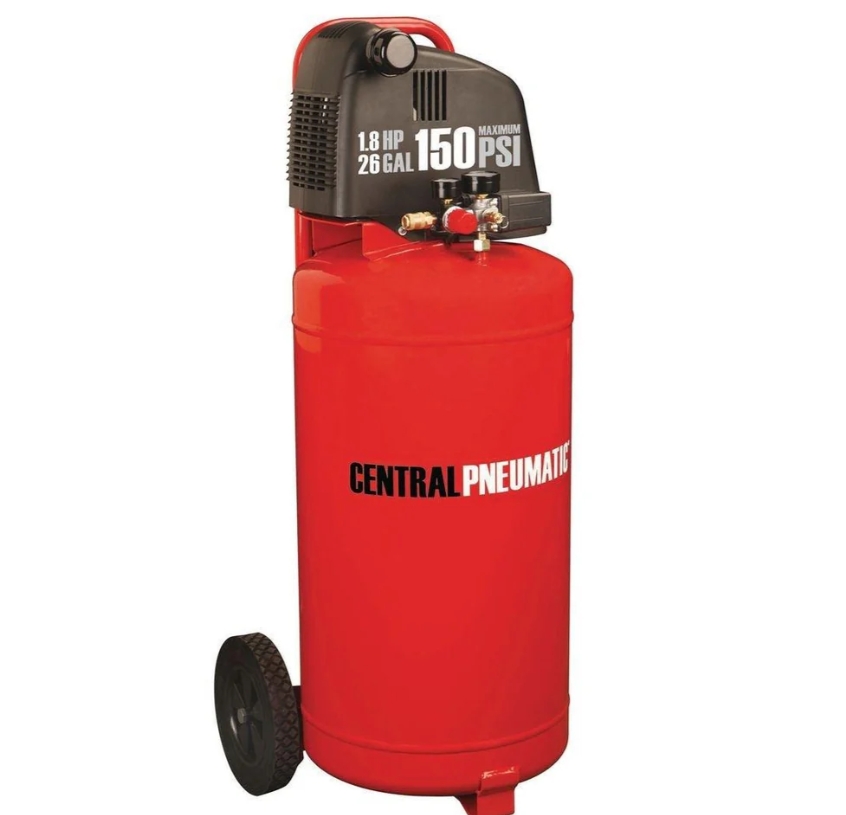
26 gallon 1.8 HP 150 PSI Oil-Free Air Compressor
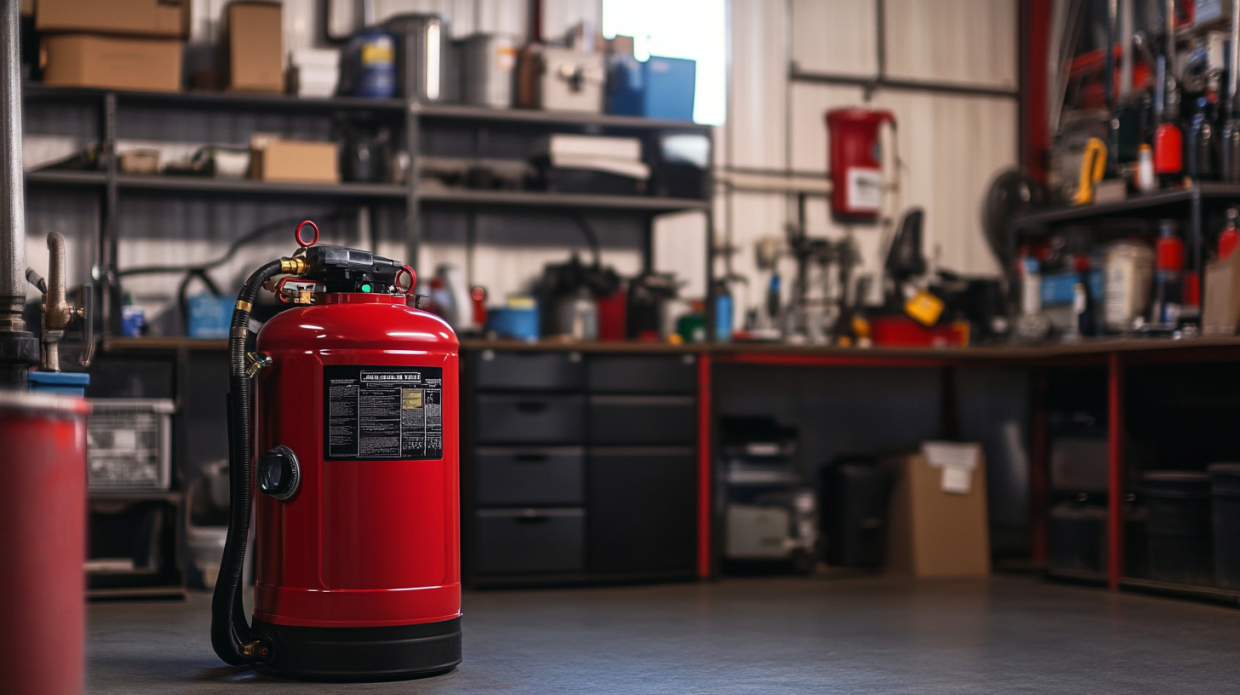
- The generous 26 gallon tank on this air compressor gives you more air for longer run times with less recycling. This air compressor’s low maintenance, oil-free design provides longer service life with less hassle. Features include a conveniently placed handle, smooth rolling wheels for easy mobility and a fully shrouded pump and motor for protection.
- Air delivery: 4 CFM @ 90 PSI, 5 CFM @ 40 PSI
- Low maintenance oil-free pump
- Built-in handle for easy maneuvering
- 9-5/8 in. diameter wheels for easy portability
$189.97
After spending fifteen years in my garage workshop experimenting with just about every power tool on the market, I’ve discovered that a reliable air compressor is the backbone of any serious DIY setup. Three years ago, I took the plunge and invested in the Central Pneumatic 26 Gallon Air Compressor, and it’s completely transformed my weekend projects. Whether you’re a curious beginner or a seasoned workshop veteran looking for an upgrade, I’ve compiled everything I’ve learned about this workshop essential.
My Discovery Journey
The first time I fired up my Central Pneumatic 26 Gallon, I felt like I’d been working with one hand tied behind my back all those years. Suddenly, my nailer worked faster, my impact wrench had real torque, and I could blast dust from tight corners with the precision of a surgeon. But the path to compressor enlightenment wasn’t without its bumps.
When I initially started researching air compressors, the options seemed endless and the technical specifications might as well have been written in ancient Sanskrit. PSI? CFM? SCFM? It was a alphabet soup of confusion. What size did I need? Was Central Pneumatic a reliable brand? Could I justify the cost?
After countless hours of research, YouTube video binges, and pestering every tool-savvy friend I know, I finally made my decision. Today, I’m sharing what I wish someone had told me before I started this journey.
The Nuts and Bolts: What Exactly Is the Central Pneumatic 26 Gallon Air Compressor?
At its core, the Central Pneumatic 26 Gallon is a workhorse designed for the serious hobbyist or light professional use. It’s a vertical tank design that balances power with a reasonable footprint in your workspace.
The compressor is manufactured by Harbor Freight Tools under their Central Pneumatic brand, which has become known for offering decent quality tools at price points that won’t send your spouse into cardiac arrest when they check the credit card statement.
Key Specifications That Matter
I’ve found that understanding the key specs is crucial to knowing if this compressor will meet your needs:
- Maximum PSI: 125 PSI, which is more than adequate for most household and garage applications
- Delivery: 5.4 CFM at 90 PSI, which determines how well it can run air-hungry tools
- Motor: 2.5 HP (peak), running on standard 120V household current
- Tank Size: 26 gallons, which provides a good balance of air storage and floor space
- Pump Type: Oil-lubricated, cast iron, single-stage pump
- Weight: Approximately 200 pounds
- Dimensions: Roughly 19″ x 19″ x 43″
- Noise Level: Around 88 dB (I’ll talk more about this later—it’s not whisper-quiet!)
The vertical design is something I’ve really come to appreciate. Unlike horizontal compressors that seem to always be in the way, this stands tall against the wall, preserving precious floor space in my already cramped garage.
Price Point: What Should You Expect to Pay?
Let’s talk money—because that’s often the deciding factor. The Central Pneumatic 26 Gallon typically retails between $329-$399, though I’ve seen it on sale for as low as $299 during major Harbor Freight promotions.
Is this a good deal? After comparing with comparable models from DeWalt, Craftsman, and Husky, I’d say the Central Pneumatic offers excellent value for the price-to-performance ratio. You’re looking at $100-300 less than competing models with similar specifications.
That said, Harbor Freight frequently runs sales and offers coupons that can bring the price down significantly. I managed to snag mine with a 20% off coupon, which made the decision that much easier. If you’re not in a rush, watching for these promotions can save you a bundle.
Hidden Costs to Consider
The sticker price isn’t the full story, though. Plan on spending a bit more for:
- Quality air hose: $30-50
- A decent filter/regulator unit: $25-40
- Various fittings and adapters: $20-30
- Oil for maintenance: $10-15
All told, budget an extra $75-125 to get everything you need to actually use the compressor effectively. It’s still a bargain compared to the higher-priced brands, but these extras shouldn’t come as a surprise.
How Does It Compare to Other Brands?
This is where things get interesting. After using the Central Pneumatic for three years and having friends with various other brands, I can offer some honest comparisons.
Central Pneumatic vs. DeWalt
DeWalt compressors have a well-earned reputation for reliability and come with a better warranty (typically 3 years vs. 1 year for Central Pneumatic). However, a comparable DeWalt model will cost you $500-700. Is it worth the extra money? If you’re using it professionally every day, perhaps. For weekend warriors like me, the Central Pneumatic hits the sweet spot.
Central Pneumatic vs. Craftsman
Craftsman has a similar price point to Central Pneumatic these days, usually running $50-100 more. The build quality is comparable, though some parts (particularly the regulator and gauges) seem more robust on the Craftsman. That said, performance specifications are nearly identical, making the Central Pneumatic still a strong contender.
Central Pneumatic vs. Husky
Home Depot’s Husky brand compressors are direct competitors, and honestly, they’re quite similar in build quality and performance. The main advantage of Husky is the more accessible service network through Home Depot, while Central Pneumatic parts sometimes require ordering directly from Harbor Freight.
The Verdict on Comparisons
After countless hours in forums and talking to other DIY enthusiasts, the consensus seems to be that the Central Pneumatic delivers about 80-90% of the performance of premium brands at 50-60% of the cost. For most home users, that’s an excellent trade-off.
Is It Suitable for Home Use?
Absolutely! In fact, I’d argue it’s ideal for home use for several reasons:
- Capacity matches typical home needs: The 26-gallon tank provides enough air reservoir for most common tasks without constant cycling.
- Power requirements fit standard outlets: Unlike larger commercial compressors, this runs on standard 120V, so you won’t need to rewire your garage.
- Versatility for various projects: Whether you’re framing a wall, installing trim, inflating tires, or blowing dust from electronics, this compressor handles it all.
- Size is manageable: While not exactly lightweight, the vertical design makes it feasible for home workshops where space is at a premium.
That said, there are some considerations for home users. At 88 dB, it’s about as loud as a blender on high speed. Your family (and neighbors) will definitely notice when it’s running. I’ve found running it during reasonable hours and considering some sound dampening measures helps keep domestic harmony.
The Power Question: Maximum PSI and What It Means
The Central Pneumatic 26 Gallon delivers a maximum pressure of 125 PSI, which sits right in the sweet spot for most applications. But what does this actually mean for your projects?
PSI (pounds per square inch) is just one part of the equation. What matters more for many tools is the CFM (cubic feet per minute) delivery. This compressor delivers 5.4 CFM at 90 PSI, which is enough to run:
- Nailers and staplers (which need minimal air)
- Most impact wrenches (though it may need time to recover between uses)
- Die grinders and cut-off tools (with some limitations)
- Paint sprayers for small to medium projects (more on this later)
The compressor will cycle on when pressure drops to about 95 PSI and off when it reaches 125 PSI. This cycling is normal and ensures you always have adequate pressure for your tools.
For context, here’s what some common air tools require:
- Brad nailer: 0.5-0.9 CFM
- Framing nailer: 2.2-2.5 CFM
- 3/8″ impact wrench: 2.5-3.5 CFM
- Paint sprayer: 4-12 CFM (depends on the nozzle size)
- DA sander: 6-9 CFM
As you can see, this compressor handles most standard tasks but might struggle with continuous high-demand applications like painting large surfaces or heavy sanding. For those, you’d need to work in intervals, allowing the compressor to catch up.
Setting Up Your Central Pneumatic 26 Gallon for the First Time
I remember unpacking my compressor with equal parts excitement and intimidation. If you’re in the same boat, here’s a step-by-step guide to getting started:
- Unboxing and placement: Find a level, clean surface for the compressor. The vertical design needs stable footing, and the unit should be at least 18 inches from any wall for proper ventilation.
- Oil check: Before doing anything else, check the oil level in the sight glass. It should be roughly in the middle of the red circle. Mine came properly filled, but it’s always worth checking.
- Break-in procedure: This is crucial and often overlooked. For the first hour of operation:
- Open the tank drain valve
- Turn on the compressor and let it run for 15-20 minutes with no load
- Close the drain valve and allow the tank to pressurize
- Once it reaches maximum pressure and shuts off, release all the air by pulling the safety valve ring
- Repeat this process of pressurizing and releasing 2-3 times
- Check for leaks: Apply soapy water to all connections and look for bubbles that indicate air leaks. Tighten as needed.
- Install your accessories: Now is the time to add your regulator, filter, quick-connect fittings, and hose.
This break-in period helps seat the piston rings properly and ensures the pump components wear in correctly. It might seem tedious, but skipping this step can significantly reduce the lifespan of your compressor.
The Compatibility Question: What Tools Can You Use?
One of the most common questions I get from friends considering this compressor is what tools it can handle. Based on my experience, here’s a comprehensive breakdown:
Tools That Work Great
- All pneumatic nailers and staplers: From delicate 23-gauge pin nailers to heavy framing nailers, they all work flawlessly.
- Impact wrenches up to 1/2″: Perfect for automotive work and general assembly.
- Tire inflators and blow guns: These low-demand tools are a perfect match.
- Ratchets and small air drills: Work great for intermittent use.
- Small to medium spray guns: HVLP detail guns work particularly well.
Tools That Work With Limitations
- 3/4″ impact wrenches: They’ll work, but expect the compressor to cycle frequently.
- Air sanders: Usable for small projects, but the compressor will struggle to keep up during extended use.
- Large spray guns: Fine for small areas, but for painting a car or large pieces of furniture, you’ll need to work slowly.
- Air hammers: Work well for short bursts but not continuous operation.
Tools That Exceed Capabilities
- Sanders for extended use: The continuous high air demand will have your compressor running constantly.
- Sandblasting equipment: Most require 10+ CFM continuously.
- Industrial paint sprayers: Large tips demand more air than this compressor can deliver.
- Plasma cutters: These specialized tools generally need more air volume.
Remember that you can always use a tool that exceeds the compressor’s continuous capacity if you’re willing to work in shorter bursts with recovery time. I’ve successfully used air-hungry tools like DA sanders by simply adjusting my workflow to match the compressor’s recovery rate.
Longevity: How Long Will It Last?
The million-dollar question for any tool investment: how long will it serve you? Based on my experience and countless forum discussions, a properly maintained Central Pneumatic 26 Gallon compressor typically lasts 5-8 years with regular home use.
Commercial users running the compressor daily might see 3-5 years before major components need attention. Considering the price point, that’s actually quite reasonable.
Factors that influence longevity include:
- Maintenance routine: Those who religiously change oil and drain moisture see much longer lifespans.
- Usage patterns: Short, frequent cycles wear components faster than longer, less frequent ones.
- Environment: Compressors in hot, humid, or dusty environments face more stress.
- Power quality: Clean, stable power extends motor life significantly.
I’ve had mine for three years with zero issues beyond routine maintenance, and it shows no signs of slowing down. That said, I’m meticulous about maintenance, which brings us to our next topic.
Maintenance: Keeping Your Investment Running Smoothly
If there’s one thing I’ve learned about air compressors, it’s that a little preventive maintenance goes a very long way. Here’s my routine that has kept my compressor running flawlessly:
Daily/After Each Use
- Drain the tank: Water condenses in the tank during use, and leaving it there leads to rust. I simply open the drain valve at the bottom of the tank until all moisture is expelled. This takes 30 seconds but adds years to your compressor’s life.
Monthly
- Check oil level and condition: The sight glass should show oil in the middle of the red circle. If it’s dark or cloudy, it’s time for a change.
- Inspect air filter: A dirty filter restricts airflow and makes the motor work harder. Clean or replace as needed.
- Tighten fasteners: Vibration can loosen bolts and fittings over time. A quick once-over with a wrench prevents problems.
- Check belt tension: If your model has a belt drive, ensure it has about 1/4″ to 1/2″ of give when pressed firmly.
Quarterly
- Change oil: I use SAE 30 non-detergent compressor oil. The process is similar to changing oil in a lawn mower—drain the old, refill with new.
- Clean the exterior: Dust can insulate the motor and cause overheating. A clean compressor runs cooler and lasts longer.
Annually
- Replace air filter: Even if it looks clean, microscopic particles can restrict airflow.
- Check safety valve: Pull the ring to ensure it opens freely and reseats properly.
- Inspect pressure switch: Make sure it cycles on and off at the correct pressures.
This maintenance schedule takes maybe 2-3 hours per year total, but it’s the difference between a compressor that lasts 2 years and one that lasts 8 years or more.
Common Problems and Troubleshooting
No tool is perfect, and the Central Pneumatic is no exception. Here are the most common issues owners encounter and how to address them:
Problem 1: Compressor Won’t Start
Possible causes and solutions:
- No power: Check the outlet with another device and verify the circuit breaker hasn’t tripped.
- Thermal overload: If the motor was running hot, the thermal protection may have engaged. Wait 30 minutes and try the reset button (usually red) on the motor.
- Pressure switch failure: If the tank has pressure but the switch doesn’t activate when pressure drops, it may need replacement.
- Failed capacitor: Motor hums but doesn’t start? The start capacitor may need replacement.
Problem 2: Compressor Runs But Doesn’t Build Pressure
Possible causes and solutions:
- Air leak: Spray soapy water on connections to locate leaks, then tighten or apply thread sealant.
- Drain valve open: A simple check, but we’ve all done it!
- Intake filter clogged: Clean or replace the air filter.
- Failed reed valve: This requires disassembly of the pump head to inspect and possibly replace the valve plate assembly.
Problem 3: Compressor Cycles Too Frequently
Possible causes and solutions:
- Tank check valve leaking: Listen for air escaping from the pump head when the compressor is off.
- Undersized for application: The tool may require more air than the compressor can deliver.
- Pressure switch range too narrow: Some pressure switches can be adjusted to provide a wider operating range.
Problem 4: Unusual Noise
Possible causes and solutions:
- Low oil level: Check and refill as needed.
- Loose pulley or flywheel: Tighten the setscrew.
- Internal pump damage: Significant mechanical noise may indicate worn bearings or piston damage.
- Vibration: Check mounting bolts and consider anti-vibration pads.
Problem 5: Oil in the Air Output
Possible causes and solutions:
- Over-filled oil reservoir: Drain to the proper level.
- Worn piston rings: This is more serious and may require professional repair.
- Install an inline filter: A coalescing filter can remove oil mist from the air line.
In my experience, the most common issues are the simplest ones—forgotten drain valves, loose fittings, and clogged filters account for probably 80% of problems. Start with the obvious before assuming a major component has failed.
What Do the Reviews Say?
I’ve scoured hundreds of reviews across multiple platforms to get a consensus on the Central Pneumatic 26 Gallon, and the pattern is clear:
Positive Trends
- Value for money: Consistently rated highly for offering good performance at a competitive price.
- Adequate power for home use: DIYers and hobbyists find it meets their needs effectively.
- Reliable performance: Most users report few issues when properly maintained.
- Good for automotive work: Particularly popular among home mechanics for tire changes and impact wrench use.
Negative Trends
- Noise level: Frequently cited as louder than expected.
- Quality control variation: Some units have issues out of the box, suggesting inconsistent quality control.
- Limited warranty: The 90-day to 1-year warranty (depending on when purchased) is shorter than competitors.
- Customer service challenges: Some users report difficulties getting support from Harbor Freight.
The overall rating across platforms averages around 4.1 out of 5 stars, which reflects my own experience—not perfect, but a solid performer that outdelivers its price point.
Can You Use It for Painting?
This is a nuanced question that depends on several factors. I’ve used my Central Pneumatic 26 Gallon for various painting projects, and here’s what I’ve learned:
What Works Well
- Small touch-up projects: Detail work and small area touch-ups work perfectly.
- HVLP guns with 1.0-1.3mm tips: These lower-flow tips match well with the compressor’s output.
- Priming or painting small furniture pieces: Single chairs, small tables, or cabinets are manageable.
What’s Challenging
- Large surface areas: Full walls, multiple furniture pieces, or exterior siding demand more continuous air than this compressor can provide.
- Spray guns with larger tips: 1.8mm or larger tips consume more air than the compressor can continuously deliver.
Tips for Painting Success
If you plan to use this compressor for painting, I recommend:
- Choose the right spray gun: Look for HVLP guns with lower CFM requirements (check the specifications).
- Thin your paint properly: Properly thinned paint requires less air pressure to atomize correctly.
- Take breaks: Allow the compressor to catch up by working in sections rather than continuous spraying.
- Install a good filtration system: Multiple stages of filtration ensure no oil or water contaminates your finish.
- Consider pressure pot systems: These require less continuous air than conventional spray guns.
With these adaptations, I’ve successfully completed numerous painting projects with this compressor. It’s not ideal for production work, but for occasional use, it performs admirably.
Noise Level: Prepare Your Ears
I won’t sugarcoat this: the Central Pneumatic 26 Gallon is loud. At approximately 88 dB, it’s about as loud as a food blender or lawnmower. For context, prolonged exposure to sounds above 85 dB can cause hearing damage.
This noise level is fairly standard for compressors in this class—more expensive models aren’t necessarily quieter unless specifically designed (and marketed) as low-noise units, which typically cost significantly more.
Mitigating the Noise
I’ve implemented several strategies to make the noise more manageable:
- Wear hearing protection: Simple but effective.
- Install vibration isolation pads: These rubber pads reduce vibration transfer to the floor, which can cut down on noise.
- Build an enclosure: A simple box lined with acoustic foam can significantly reduce noise, though you must ensure adequate ventilation.
- Strategic placement: Placing the compressor in a corner with hard surfaces can actually amplify noise. Center placement or using sound-absorbing materials nearby helps.
If noise is a major concern for your situation (shared walls with neighbors, home workshop near living spaces, etc.), you might want to consider investing in a more expensive “quiet” compressor. However, be prepared for sticker shock—they typically start at $700-800 for comparable specifications.
Warranty and Support
The Central Pneumatic 26 Gallon typically comes with a 90-day warranty, though Harbor Freight occasionally offers promotional 1-year or 2-year warranties. This is admittedly shorter than many competitors, which typically offer 1-3 years of coverage.
Extended warranty plans are available at additional cost, usually around $50-70 for 1-2 years of additional coverage. Whether this is worth it depends on your risk tolerance and how critical the compressor is to your work.
In my experience, most issues that develop do so either:
- Very early (first few uses), which the standard warranty covers
- After several years of use, by which time extended warranties have expired anyway
The middle ground where extended warranties pay off is relatively narrow, making them questionable value for most users.
Support Options
If you do encounter issues, Harbor Freight offers several support channels:
- In-store assistance at any Harbor Freight location
- Phone support via their customer service line
- Email support through their website
In my limited interactions with their support (I had a question about an accessory), the in-store staff were surprisingly knowledgeable and helpful. Your mileage may vary, but don’t dismiss the value of being able to walk into a physical location with questions.
Can It Handle Industrial Applications?
This is where we need to be realistic about the Central Pneumatic’s capabilities. While it’s an excellent compressor for DIY and home shop use, it’s not designed for continuous industrial applications.
Limitations for Industrial Use
- Duty cycle: The compressor is designed for intermittent use, not continuous operation.
- Air delivery: At 5.4 CFM @ 90 PSI, it’s below the threshold needed for many industrial tools.
- Components: The valves, switches, and other components aren’t built for the rigors of daily, all-day use.
- Warranty: The limited warranty isn’t compatible with the needs of business users who depend on their tools.
Appropriate Industrial Applications
That said, there are some light industrial scenarios where this compressor could serve adequately:
- Small repair shops with intermittent pneumatic tool use
- Mobile service vehicles where space and weight are considerations
- Backup or supplementary air in larger shops
- Light manufacturing with low air demands
If your business depends on compressed air, this probably shouldn’t be your primary compressor. Consider it an auxiliary unit or a starting point until you can invest in a true industrial-grade system.
Power Requirements: What You Need to Know
The Central Pneumatic 26 Gallon runs on standard 120V household current, which is both a convenience and a limitation. Here’s what you need to know about powering this compressor:
Circuit Requirements
- Amperage: The compressor draws approximately 15 amps at startup and 7-8 amps while running.
- Circuit breaker: A dedicated 20-amp circuit is ideal, though a 15-amp circuit may suffice if nothing else is running on it.
- Extension cords: If absolutely necessary, use only 12-gauge or heavier cords, and keep them as short as possible.
Startup Considerations
The initial startup draws the most power as the motor overcomes inertia. This “inrush current” can trip breakers, especially if:
- The circuit is already loaded with other devices
- You’re using a long or undersized extension cord
- Your home has marginal electrical service
I’ve found that turning off other high-draw devices before starting the compressor prevents most circuit overload issues.
Generator Compatibility
If you’re planning to run this compressor from a generator (for job sites or during power outages), you’ll need a generator rated for at least 4000 watts, with 5000 watts being a safer minimum. The startup surge requires significantly more power than the running wattage.
Replacement Parts: Availability and Costs
One concern with any tool purchase is the long-term availability of parts. For the Central Pneumatic 26 Gallon, replacement parts are generally available through several channels:
- Harbor Freight directly: They stock common replacement parts like pressure switches, gauges, and drain valves.
- Third-party suppliers: Many components are standard across multiple brands and available from pneumatic supply companies.
- Online marketplaces: Sites like eBay and Amazon offer both OEM and compatible aftermarket parts.
Common Replacement Parts and Costs
Based on current pricing, here’s what you might expect to pay for common replacement parts:
- Pressure switch: $15-25
- Regulator assembly: $20-30
- Gauge: $8-15
- Check valve: $12-20
- Belt (if applicable): $15-25
- Complete pump head: $150-200
- Motor: $120-180
Most of these parts are relatively straightforward to replace with basic mechanical skills and standard tools. I’ve replaced the pressure switch on mine, and it was a 15-minute job with just a wrench and screwdriver.
The availability of these components means that even after the warranty expires, you can keep your compressor running for many years through repairs rather than replacement.
Draining Water: A Critical Maintenance Task
I can’t emphasize enough the importance of regularly draining water from your air compressor tank. This single maintenance task does more to extend the life of your compressor than perhaps all others combined.
Why Water Accumulates
As air compresses, its ability to hold moisture decreases, causing water vapor to condense inside the tank. This is especially problematic in humid environments, where a single day’s use can result in significant water accumulation.
How to Drain the Tank Properly
The Central Pneumatic 26 Gallon has a manual drain valve at the bottom of the tank. Here’s the proper procedure:
- Turn off the compressor: Always drain with the power off.
- Release pressure: Reduce tank pressure to below 10 PSI using the regulator and an air gun, or by slowly opening the drain valve.
- Open the drain valve fully: Turn counterclockwise until completely open.
- Tilt if necessary: Slightly tilting the compressor helps ensure all water drains out.
- Close when complete: Close the valve snugly but not over-tight.
I perform this ritual after every significant use session, without fail. It takes less than a minute but prevents potentially catastrophic internal tank rusting.
Upgrade Options
If manual draining becomes tedious, consider these upgrades:
- Electronic auto-drain valve: $40-70, automatically purges at set intervals
- Ball valve replacement: $15-20, makes manual draining easier with quarter-turn operation
- Extended drain tube: $10-15, routes water away from the compressor base
These small investments can make maintenance more convenient, increasing the likelihood you’ll actually do it regularly.
Where to Buy: Finding the Best Deal
The Central Pneumatic 26 Gallon Air Compressor is primarily sold through Harbor Freight Tools, though you may occasionally find it through third-party sellers online. Here are your main purchasing options:
Harbor Freight Stores
Advantages:
- Can inspect the actual unit before purchase
- Immediate availability (no shipping wait)
- No shipping costs
- Can purchase extended warranty in person
- Easy returns if needed
Disadvantages:
- Must transport a 200-pound item yourself
- Limited to store hours
- May not have stock at all locations
Harbor Freight Online
Advantages:
- Convenient shopping from home
- Occasionally offers online-only promotions
- Can be shipped directly to your location
Disadvantages:
- Shipping can be expensive ($75-100 for freight)
- Can’t inspect before purchasing
- Returns more complicated than in-store
Third-Party Sellers
Occasionally you’ll find this compressor on marketplaces like eBay or Amazon, but I generally recommend caution with these sources unless they’re authorized retailers. The shipping of such a heavy item can lead to damage, and warranty support may be complicated.
Getting the Best Price
To maximize your savings:
- Watch for sales: Harbor Freight runs regular promotions, especially around holidays
- Use coupons: Their famous coupons can often save 20-25%
- Sign up for their Inside Track Club: Members get early access to special pricing
- Consider floor models: Sometimes display units are sold at a discount
With strategic timing, you can potentially save $75-100 off the regular price.
Final Verdict: Is This the Right Compressor for You?
After three years with the Central Pneumatic 26 Gallon Air Compressor and thousands of hours in online forums reading others’ experiences, I can offer this conclusion:
The Central Pneumatic 26 Gallon Air Compressor is an excellent value choice for DIY enthusiasts, home shop owners, and light professional use. It balances performance, price, and reliability in a way few competitors can match.
Ideal For:
- Weekend warriors tackling home improvement projects
- Automotive enthusiasts working on personal vehicles
- Woodworkers running nailers and small air tools
- Small shop owners with intermittent compressed air needs
- Those new to air tools who want to start with a capable but affordable system
Not Ideal For:
- Production environments requiring continuous compressed air
- Applications demanding absolutely quiet operation
- Users needing more than 5.4 CFM consistently
- Those who prioritize warranty length and premium customer service over price
The Central Pneumatic 26 Gallon isn’t the most powerful, the quietest, or the most durable compressor on the market. What it is, however, is a remarkably capable machine at a price point that makes compressed air accessible to nearly any serious DIYer.
With proper maintenance and realistic expectations about its capabilities, this compressor can serve as the heart of your pneumatic system for many years, powering projects from simple tire inflation to furniture building, automotive work, and beyond.
If you’re on the fence, I hope my experience helps you make an informed decision. In my workshop, this compressor has more than paid for itself in both the projects it’s enabled and the satisfaction of having the right tool for the job.
Remember, a reliable air compressor is the backbone of any serious DIY setup, and the Central Pneumatic 26 Gallon has proven itself worthy of that critical role in countless home shops across the country—including mine.